Light Industrial Space for Sale Singapore: Verifying the Right Industrial Use Before Committing
Buying light industrial space in Singapore can feel straightforward at first glance. You see a unit that fits your budget, a strata layout that looks workable for your workflows, and a zoning label that sounds like the right category. Then the due diligence questions start piling up, and the deal stops being about price. It becomes about one thing: whether the way you intend to operate is actually allowed, and sustainable under the approved use.
In industrial properties, “allowed use” is not a minor technicality. It affects everything that comes after purchase, from what you can install and run, to whether you can get approvals for changes, to whether future tenants will even be able to use the space you buy. For many buyers, especially those buying industrial property Singapore for investment or for their own operations, this verification step is the difference between a clean acquisition and an expensive misunderstanding.
Below is the practical way I approach it, focusing on B1 industrial property Singapore, the B1 vs B2 industrial zoning distinction, strata industrial units Singapore, and the transaction realities around freehold vs leasehold industrial Singapore and the stamp duty Singapore rules that apply to industrial deals.
Start with zoning, but verify the business use quantum too
Most buyers begin with zoning because it feels like the headline. If you are considering B1 industrial property Singapore, that label matters. B1 is intended mainly for clean industry, light industry, warehouses, public utilities and telecom uses. The underlying idea is that B1 activities should not generate nuisance levels that require large separation distances from sensitive uses.
One specific point that often gets missed is the buffer concept. The guidance indicates that uses that need a nuisance buffer of more than 50m are generally not allowed. That means your planned operations may be “light” in your own mind, but if your processes trigger buffer requirements above what B1 allows, you may not be able to operate as intended.
Then there is the operational requirement, the part that affects day-to-day fit. The use quantum guidance for B1 is clear: at least 60% of the floor area, measured as GFA, in a B1 development or strata unit must be used for industrial purposes. The remaining area is limited to ancillary, supporting uses, and approved secondary uses.
This is where many deals go off track. Buyers sometimes picture the unit as a warehouse with a small office, or a production space with a show-and-sell corner, or an operations room with a training area. But the 60% industrial-use quantum is a boundary you have to respect, even if your business is genuinely “industrial” at heart. A unit that looks physically suitable can still fail at the use quantum level if the tenant plan or your own workflow makes the non-industrial portions too large.
So the verification step I recommend is not just “Is it B1?” but “Does our intended layout, usage, and proportion of activities meet the 60% industrial-use requirement, and will the rest fall within ancillary, supporting, or approved secondary uses?”
B1 vs B2 is not just a label, it shapes the kind of operations you can plausibly run
B1 and B2 can both sound “industrial,” but the market treats them differently because they reflect different intensity expectations. The distinction matters for buyers comparing B1 vs B2 industrial zoning.
From the practical side, B2 is the heavier-industrial category. In market descriptions for B2 units, the product specs commonly reflect heavier use potential. For example, JTC unit listings for B2 units often reference higher floor loading and different height specifications compared with B1 flatted factories. That tells you the design is geared toward operations that are more demanding.
This does not mean B1 is “easy” or B2 is “only for big factories.” It means your business plan should match the category’s practical tolerance. If your plan relies on requirements that are typically aligned with heavier industrial use, a B1 unit can become an ongoing approval and compliance headache. If your plan is genuinely light, clean, and consistent with light manufacturing, food packing or processing-related work, e-business, printing and publishing, media, and similar clean uses, B1 is often the more natural fit.
The key takeaway: B1 vs B2 is not a shopping comparison. It is a risk management decision. When you verify the allowable use early, you reduce the chance that you will discover later that a part of your intended operations is constrained or needs separate approval.
“Approved use” also affects which tenants you can realistically attract later
Even if you are buying for your own operations, you should think like a future tenant. Industrial property investment Singapore is sensitive to approved use because resale liquidity and tenant demand are often trade-specific.
B1’s use control framework supports a range of clean, light activities. The guidance indicates that B1 commonly suits light manufacturing and related clean uses, including food packing or processing-related uses, e-business, and printing or publishing, as well as media and similar clean operations. Some non-industrial uses may need separate approval or can be constrained. This is the reason buyers who plan to pivot the asset in a few years should be careful.
If you buy industrial property Singapore with the assumption that “we can always switch to something else,” you may be wrong. Approved use controls can limit how flexibly the unit can be redeployed. That means your exit strategy has to match what the zoning and use quantum allow, not what is convenient at the time of purchase.
Strata industrial units: technical checks matter as much as zoning
Strata industrial units Singapore often come with a mix of practical engineering constraints and approved-use constraints. In light industrial space for sale Singapore, buyers can focus so hard on zoning that they forget to check the unit’s ability to support the physical requirements of the intended trade.
For strata units, the technical checks typically include floor loading, ceiling height, goods-lift access, loading-bay provision, and whether your trade matches the approved use. These are not academic items. If your workflow needs certain loading capacity, if you rely on goods-lift access for throughput, or if you operate with a predictable loading pattern, a mismatch can turn the unit into an operational bottleneck.
A unit that is approved for a category of use but has unsuitable specs can become expensive to retrofit. And if retrofit triggers additional approval processes, you can end up paying twice: once for the retrofit, and again for the time and compliance effort.
This is why I treat the “technical suitability” verification step as a parallel track to the “permitted use” verification step. One checks whether your operations can exist within the approval framework. The other checks whether the unit can physically support how you plan to run.
Ramp-up vs flatted factories: logistics choices can change what “workable” means
Layout is one of the most underrated reasons light industrial spaces succeed or fail for their intended users.
JTC’s descriptions of ramp-up factories highlight that they provide direct vehicular access to units for loading and unloading. By contrast, flatted factories are generally accessed via common corridors, lifts, and loading bays. Both models can work, but they support different logistics patterns.
If your workflow depends on frequent truck movement, quick staging, or direct movement between vehicle and production or storage, the ramp-up approach can reduce friction. If your operation is more inward-facing and relies on centralized handling or goods movement via common facilities, a flatted configuration might still be perfectly fine.
For buyers, the practical question is simple: how does your daily movement of goods and equipment map to the building access pattern? If you only verify zoning Space Nova JVA NIR and specs, you might buy a unit that is “allowed” but still inefficient enough to erode your margins.
Freehold vs leasehold industrial: scarcity is real, but the main question is how long you can plan
Many buyers want to anchor their search around freehold vs leasehold industrial Singapore because tenure impacts certainty and long-term value.
The market reality is that freehold industrial space is relatively scarce, and much new industrial supply is on leasehold land. Industrial estate and unit listings commonly show lease terms such as 60-year, 30-year, or 20-year lease terms depending on the estate and product.
In practical terms, this means your “verification” is not only about zoning and allowable use. It also includes time horizon. A leasehold industrial investment Singapore buyer needs to model whether their business plan, tenant profile, and capex cycle align with the remaining lease term at the time of purchase.
If your intended use is stable and your business model is conservative, a shorter remaining lease might still be acceptable. If you need to build a specialized operation with longer payback cycles, leasehold constraints can become a decisive factor. Freehold buyers often pay a premium for optionality, but even then, permitted use still governs what you can operate.
New launch industrial property Singapore: plan for what approvals allow today, not just what you like on paper
When you look at new launch industrial property Singapore, your instinct is to focus on fresh facilities and the future. The issue is that approvals and permitted use quantum do not care that the building is new. The unit must still satisfy the zoning’s operational expectations, including the B1 requirement that at least 60% of GFA be used for industrial purposes in B1 developments or strata units.
So, for any ramp-up industrial units Singapore or other new configurations, the verification should include whether your intended operational footprint can realistically reach the required industrial-use proportion. New buildings can reduce maintenance surprises, but they do not remove the constraint that a non-industrial or secondary-use portion must stay within allowed categories.
City-fringe areas: why location can help, but why zoning still decides the outcome
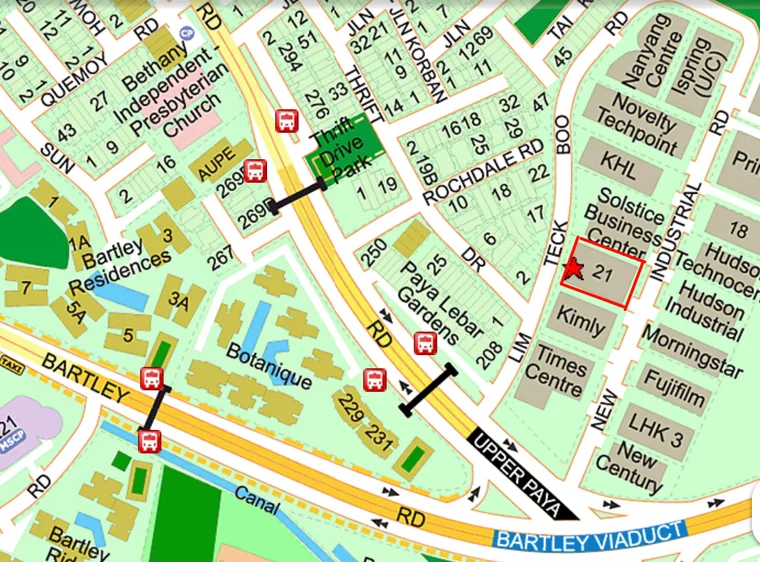
City-fringe industrial property Singapore precincts, such as Tai Seng industrial property and Paya Lebar industrial property, are commonly favored for e-commerce, light manufacturing, R&D, and urban logistics because they are closer to workforce catchments and transport links. These locations often align well with the clean, light use profile that B1 zoning is designed for.
But location should be treated as a demand tailwind, not a permission slip. If a unit is approved for B1, the use quantum and allowable-use conditions still govern. A city-fringe address can make operations easier and improve tenant interest, yet it cannot override the approved use framework.
If you are an investor comparing where to park capital, it still comes back to the same verification: is the unit’s approved use aligned with your projected tenant profile, and can the tenant fit within the B1 industrial-use quantum requirement?
Stamp duty and GST: industrial deals follow normal rules, not residential assumptions
Once the permitted use is verified, the transaction mechanics matter. Buyers often accidentally carry residential assumptions into industrial purchases, especially when they hear terms like ABSD.
For industrial property stamp duty Singapore, one critical point is that industrial property is not subject to Additional Buyer’s Stamp Duty. ABSD applies to residential property acquisitions, while industrial transactions follow normal BSD rules. On disposal, seller’s stamp duty for industrial property may apply where relevant.
If you sell the industrial property, IRAS applies Seller’s Stamp Duty for industrial property disposals based on holding period: 15% if sold within 1 year, 10% within 1 to 2 years, 5% within 2 to 3 years, and none after 3 years.
Also, if you are buying a new non-residential property from a GST-registered seller or developer, GST is payable on the purchase, since IRAS indicates buyers of non-residential properties must pay GST if the seller is GST-registered.
These stamp-duty and GST points are not about compliance theatre. They directly shape your total cost, your required rent or operating surplus, and your investment timing. If you plan a quick turnaround, SSD rates become a real component of your net return.
Buying under company name: structure is common, but stamp duty treatment is specific
Many investors buy industrial assets under a company name, especially when the space is used for business or held for investment. IRAS stamp-duty rules treat entities differently mainly in the residential ABSD context, but for industrial disposals, seller’s stamp duty can apply regardless of buyer profile, based on holding period.
If you are considering buying industrial property under company name, the verification you should do is twofold. First, confirm the stamp duty rules that apply to your situation for the acquisition and any later disposal. Second, align your operational plan with the permitted use so you do not create a mismatch that is expensive to fix later through approvals.
Industrial property loan Singapore: underwriting cares about how the asset performs, not just how you feel about the zoning
Industrial property loan Singapore is usually assessed differently from residential lending. Market practice reflects that financing for property investment depends on lender assessment, and non-residential loans are typically under commercial terms rather than residential housing loan rules.
The practical implication for buyers is that permitted use verification is also finance-relevant. If your plan is difficult to lease because it sits near the edge of allowable use, lenders can be cautious about cash flow stability. When you can demonstrate that your intended or likely tenant Space Nova showflat operations fit the B1 allowable-use framework and the 60% industrial-use quantum, you reduce ambiguity and underwriting friction.
A practical verification approach before you commit (what I would do on a real deal)
You can spend days comparing prices and floor areas, then discover at the last stage that the unit cannot support your intended use proportion or your operational assumptions. I avoid that by doing a targeted verification sequence that stays grounded in what the B1 framework requires and what strata units typically need.
Here is the short checklist I rely on:
- Confirm the unit’s zoning category and read the B1 guidance for allowable uses, including the nuisance buffer concept where applicable
- Verify the B1 use quantum requirement that at least 60% of GFA is used for industrial purposes, and map your planned layout to that proportion
- Check any constraints where the non-industrial or secondary use portion is limited to ancillary, supporting uses, or approved secondary uses
- For strata units, confirm technical suitability such as floor loading, ceiling height, goods-lift access, and loading-bay provision, and ensure the trade matches the approved use
- Review transaction timing effects like seller’s stamp duty holding period for industrial property, plus whether GST applies if buying from a GST-registered developer or seller
I keep this checklist focused on what the official B1 framework and typical strata unit checks directly tell us. Anything beyond that often becomes a second round of questions tailored to your specific process, equipment, and tenant plan.
Common pitfalls I have seen in light industrial purchases
The tricky part is that many mistakes do not look like mistakes in the beginning.
One common pitfall is assuming that “clean” automatically means “allowed.” B1 is designed for clean industry and light uses, but the guidance also highlights that uses needing a nuisance buffer of more than 50m are generally not allowed. If your process generates outputs that create a larger buffer requirement, you may be constrained.
Another pitfall is misreading the 60% GFA industrial-use quantum requirement as a guideline rather than a boundary. If your operation expands, if your storage becomes administrative space, or if you plan retail-style showrooms inside the unit, the industrial portion can fall below the threshold you need.
Then there is the technical pitfall. Buyers sometimes focus on whether the floor plan “looks right” for their machinery, but ignore items like ceiling height, goods-lift access, loading-bay provision, and floor loading. A unit can be zoned correctly and still fail operationally.
Finally, investors often underestimate the tenant-risk angle. If you buy industrial property investment Singapore hoping for generic demand, you may be surprised by how trade-specific the leasing market can be. Approved use, strata specs, and lease term all shape tenant willingness, and that shows up in rental cycles and vacancy risk.
How to think about rental yield without pretending it is uniform
A frequent question is industrial property rental yield Singapore. People want a number, but the truth is that rental yield depends on more than zoning and location. Approved use alignment, strata specs, lease tenure, and the tenant profile all affect how quickly space can be leased and at what rate it can be sustained.
What we can say from the framework is that B1 use controls influence what kinds of tenants can operate there, and technical constraints influence whether tenants can execute their workflow. That combination changes the risk profile and the liquidity of the asset.
So instead of chasing yield in isolation, verify permitted use and physical suitability first. Then you can assess whether your expected tenant operations actually fit the unit and can use the space within the B1 industrial-use quantum. When the operational fit is solid, rental discussions become more realistic and less speculative.
Where light industrial space tends to work best for buyers
If you are looking specifically at light industrial space for sale Singapore, B1 tends to align with the kind of activities the B1 category is designed for. Buyers who run or invest in clean, light operations often find the zoning fit more straightforward, especially when their intended workflow can be expressed within the requirement that at least 60% of GFA is used for industrial purposes.
That is why city-fringe clusters like Tai Seng industrial property and Paya Lebar industrial property are often appealing for urban logistics, e-business, and light manufacturing-style use. But again, location does not replace use verification.
The best outcomes come from matching three elements at once: zoning, industrial use proportion, and the unit’s physical specs. When those align, the business runs cleaner, and the asset is easier to explain to both lenders and prospective tenants.
Final thought: verify use first, then price makes sense
In industrial property transactions, price without operational certainty is a trap you cannot unwind easily. B1 is not a vague “industrial” label, it is a framework with specific allowable uses and a measurable industrial-use quantum requirement. Strata units add technical constraints such as floor loading and goods-lift access, and these constraints can make an otherwise “eligible” unit impractical.
If you are buying industrial property Singapore, whether for a long-term hold, a business expansion, or a rent-and-let investment, verifying the right industrial use before committing is the discipline that protects both your runway and your returns. When that verification is done early, negotiations get sharper, financing conversations become easier, and your exit plan stops relying on hope.